

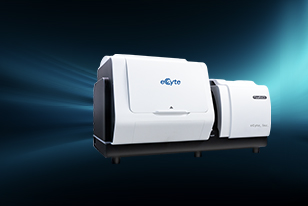


From rapid antimicrobial susceptibility testing to single-cell profiling, Ramanomics offers new ways to understand microbial responses to antimicrobial drugs.
November 18–24 marks World AMR Awareness Week 2026, under the theme “One Health, One Action: Stop Antimicrobial Resistance Now.”
Antimicrobial resistance (AMR) is a growing global challenge. As bacteria and fungi develop resistance to antimicrobial drugs, effective treatments become increasingly difficult. Addressing AMR requires more than identifying resistant pathogens. It also calls for faster susceptibility testing, deeper insights into resistance mechanisms, and continued discovery of new antimicrobial resources.
Raman spectroscopy is opening new perspectives by revealing the molecular fingerprints and metabolic responses of individual microbial cells.
1. Beyong Growth: Reading the Metabolic Pulse of Microbial Cells
Traditional antimicrobial susceptibility testing largely relies on observing microbial growth. Ramanomics offers another perspective: what is happening inside individual cells after drug exposure?
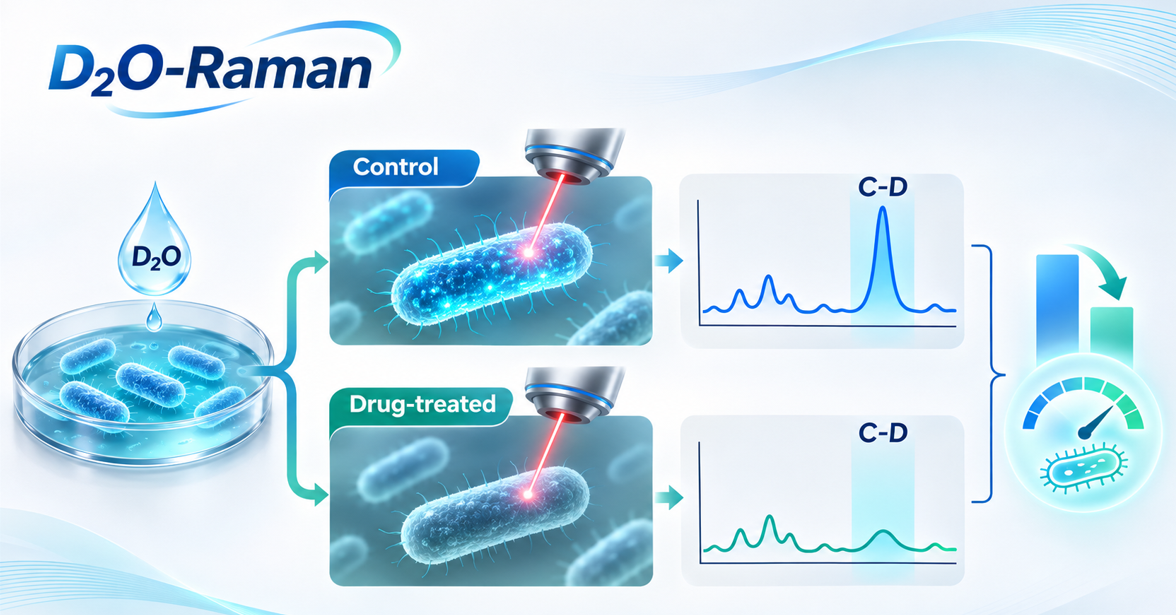
With D₂O-Raman tracing, metabolically active cells incorporate deuterium into newly synthesized biomolecules, generating C–D signals in the Raman-silent region.
By comparing drug-treated cells with untreated controls, researchers can assess changes in cellular metabolic activity at the single-cell level. This approach has also enabled the development of MIC-MA, a metabolic activity-based measure of antimicrobial inhibition.
Complementarily, intrinsic Raman fingerprints reveal changes in cellular components following drug exposure, providing another route to rapid susceptibility assessment.
2. From Resistance Detection to Mechanistic Insights
Raman-based approaches offer multiple dimensions for AMR research:
Rapid: Detect early metabolic and molecular responses to antimicrobial exposure, potentially reducing testing time to hours.
Precise: Analyze individual cells rather than relying solely on population averages, revealing heterogeneous responses.
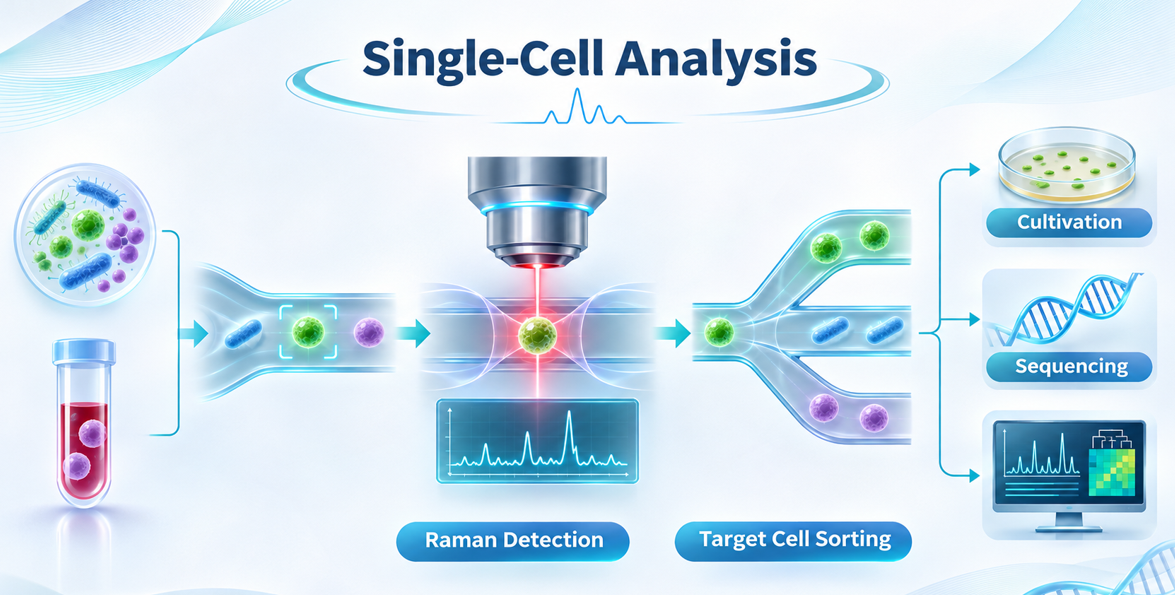
Deep: Combine Raman-based phenotyping with single-cell sorting and downstream sequencing to investigate phenotype–genotype relationships.
Broad: Explore antimicrobial responses across different microorganisms, including bacteria and fungi, as well as phage–bacteria interactions.
Quantitative: Derive measurable indicators such as C–D ratios and MIC-MA to characterize metabolic activity and drug responses.
3. From Recognition to Recovery: Enabling Single-Cell Research
Identifying a microbial phenotype is only part of the process. Recovering the corresponding living cells can open the door to further investigation.
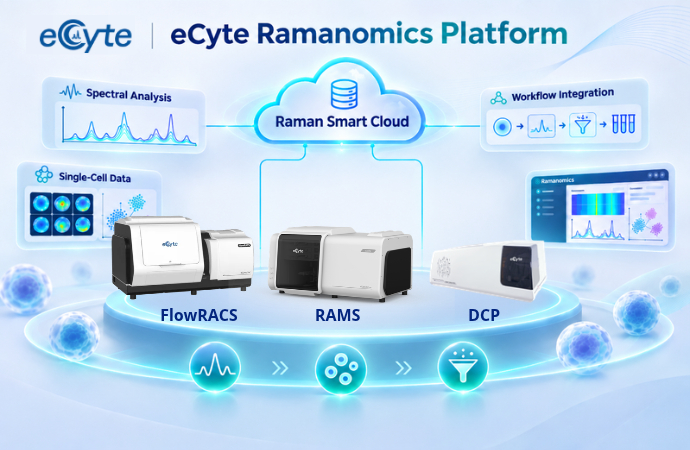
eCyte has developed a portfolio of Raman-based instruments and supporting technologies for microbial single-cell analysis and sorting, together with the Raman Smart Cloud platform for spectral analysis and data interpretation.
By integrating sample processing, Raman acquisition, spectral analysis and cell sorting, this platform supports workflows such as sort-then-cultivate and cultivate-while-sort.
Target cells can be recovered for subsequent cultivation, antimicrobial susceptibility assessment and genomic analysis, helping researchers connect single-cell phenotypes with their underlying biological characteristics.
4. Ramanomics Beyond AMR: Exploring New Antimicrobial Resources
Raman spectroscopy also contributes to the discovery and characterization of antimicrobial natural products.
Studies have demonstrated Raman-based detection and imaging of compounds produced by Streptomyces, including avermectin, amphotericin B, actinorhodin and undecylprodigiosin.
These applications extend Raman analysis from molecular identification to in situ detection and spatial mapping of secondary metabolites, offering new tools for microbial natural-product research.
5. Advancing AMR Research Through Single-Cell Technologies
From reading the metabolic pulse of individual cells to recovering target microorganisms for further investigation, Ramanomics provides a complementary approach to understanding antimicrobial responses.
Through its Raman-based platforms, including RAMS and FlowRACS, eCyte is committed to advancing single-cell Raman analysis and sorting for microbial research.
One Health, One Action: Stop Antimicrobial Resistance Now.
By connecting molecular insights, single-cell technologies and microbial resource discovery, eCyte aims to support researchers in addressing AMR challenges and exploring new possibilities in antimicrobial research.