



In a landmark study published in Nature Water, a joint research team, including the Research Center for Eco-Environmental Sciences (CAS), the Institute of Tibetan Plateau Research (CAS), the Qingdao Institute of Bioenergy and Bioprocess Technology (CAS), and Quaid-i-Azam University, has unlocked a decades-old mystery in low-carbon wastewater treatment.
By leveraging FlowRACS, the team provided direct single-cell evidence showing that quorum sensing (QS) induces a metabolic "self-sacrifice" in nitrite-oxidizing bacteria (Nitrospira). This altruistic behavior serves as the core endogenous mechanism that stabilizes short-cut nitrification.
The Challenge: A 20-Year Wastewater Bottleneck
Short-cut nitrification (nitritation) halts ammonia oxidation at the nitrite stage, drastically lowering aeration, carbon source requirements, and greenhouse gas emissions in wastewater treatment plants.
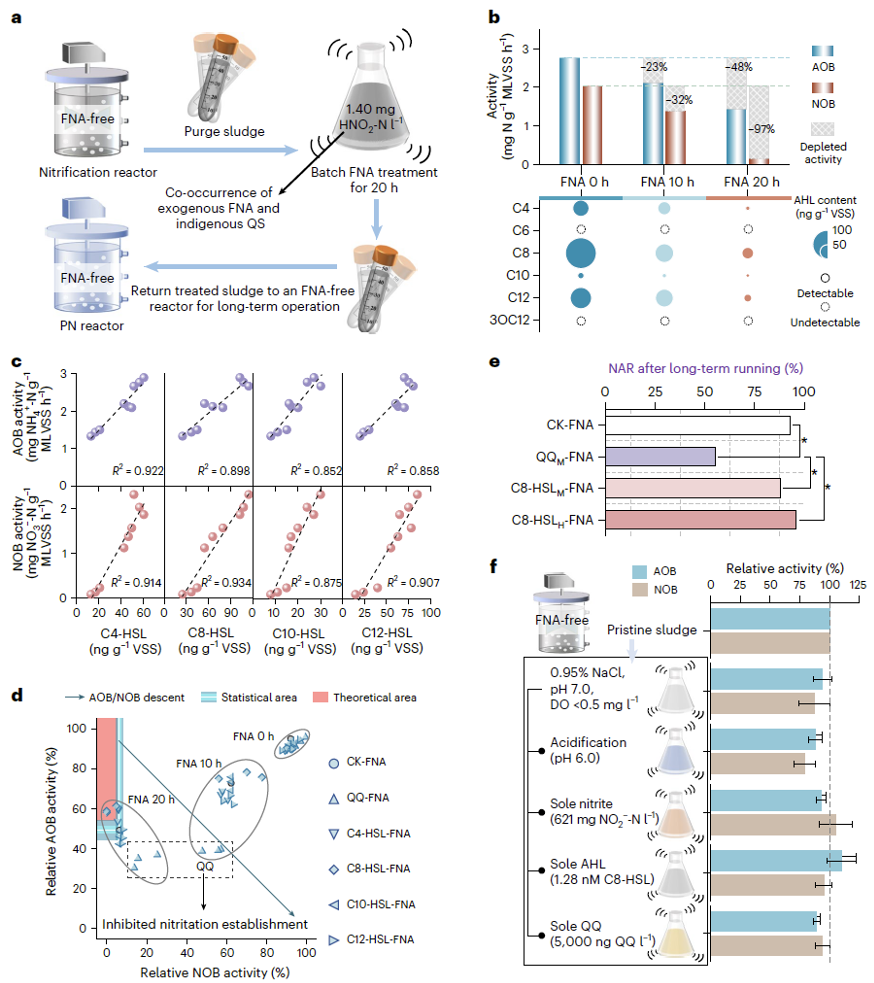
Traditionally, operators relied on macro-environmental stressors—such as controlling dissolved oxygen (DO), pH, or free nitrous acid (FNA)—to selectively suppress Nitrite-Oxidizing Bacteria (NOB) relative to Ammonia-Oxidizing Bacteria (AOB). However, these external controls often led to unpredictable NOB recovery and process collapse.
To explain this gap, the team hypothesized an endogenous biological mechanism: QS signals drive Nitrospira into an energy-intensive, altruistic detoxification pathway. By self-inactivating under FNA stress, Nitrospira mitigates communal toxicity, allowing AOB to gain a decisive competitive advantage and lock in nitrite accumulation.
Key Mechanism: Quorum Sensing-Driven "Self-Sacrifice"
Combining multi-omics, 15N isotope tracing, and single-cell Raman spectroscopy, the researchers decoded the full regulatory pathway:
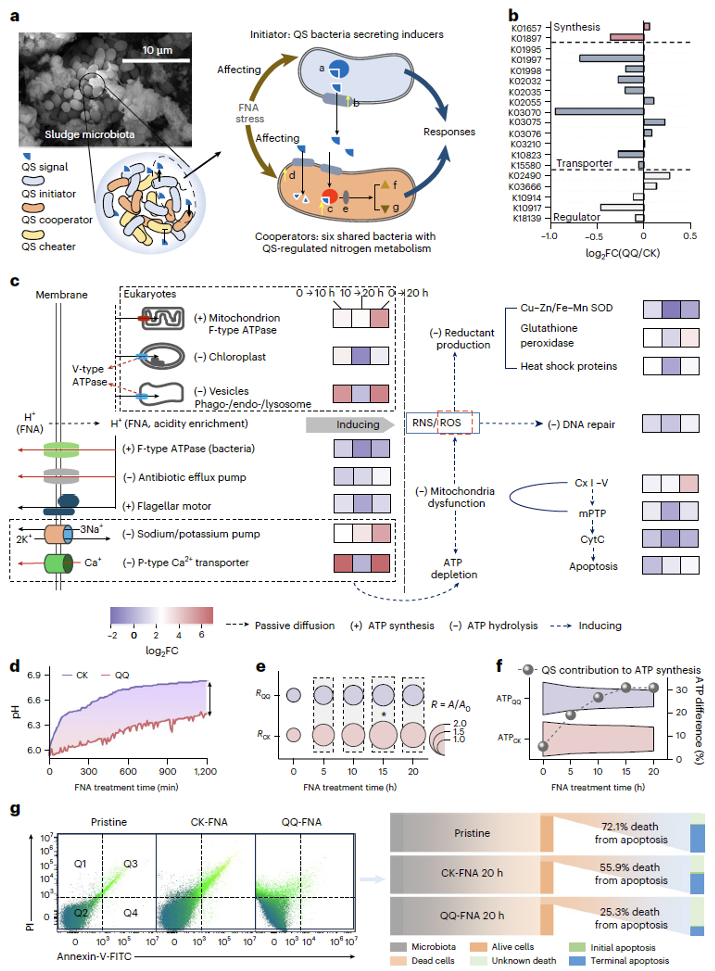
The QS Trigger: Quorum sensing signals act as the essential switch that activates the LuxR-type receptor narL in Nitrospira.
Energy-Depleting Detoxification: Upon QS activation, Nitrospira overexpresses the nirB gene, reducing nitrite to ammonium. This process drains cellular NADH and requires a high-cost glutamate–glutamine cycle.
Population Dynamics: While this altruistic reaction temporarily buffers environmental stress for the community, the severe energy deficit causes widespread Nitrospira mortality. AOB, refraining from this costly pathway, outcompete NOB and dominate the nitrifying community.
How FlowRACS Enabled the Single-Cell Breakthrough
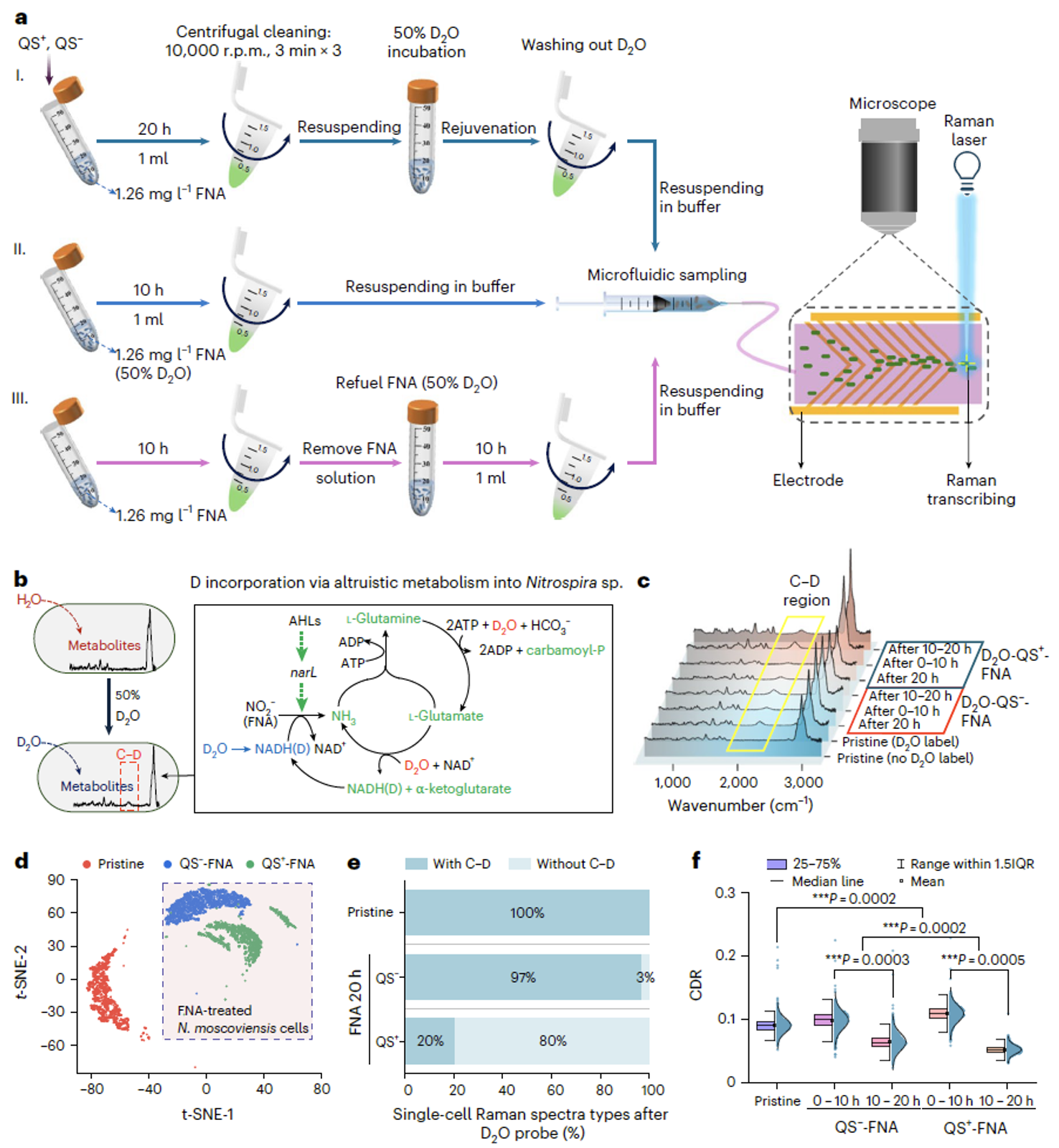
Bulk multi-omics measurements reflect population averages, which mask cell-to-cell heterogeneity. To confirm true metabolic altruism, the research team relied on FlowRACS paired with heavy water probing to quantify individual cell activity without culturing or labeling.
Why FlowRACS Was Crucial to the Discovery:
Stable Microfluidics for Flocculated Samples: Activated sludge flocs tend to settle quickly, creating data bias in conventional microfluidic devices. FlowRACS maintained a stable, continuous flow field over hours of testing.
Precision Single-Cell Focusing: FlowRACS aligned individual cells in high-velocity streams across laser detection focal points, accurately capturing faint C-D Raman peaks.
Statistical Depth Across Heterogeneous Subpopulations: FlowRACS collected over 1,000 single-cell Raman spectra per experimental group. This deep sampling yielded high-resolution t-SNE clustering that directly proved the shift in Nitrospira phenotypic states:
In QS-Deficient Conditions QS: 97% of Nitrospira cells maintained metabolic activity under FNA stress.
In Intact QS Conditions QS: Survival dropped to just 20%, representing a 26.7-fold increase in cell inactivation due to sustained altruistic metabolism.
Temporal Resolution: FlowRACS captured an initial boost in Nitrospira activity (0-10 h), followed by energy exhaustion and mass inactivation (10-20 h) — explaining the long-observed "short-term coexistence, long-term single-directional suppression" dynamic.
Research Impact: From Theory to Application
Theoretical Advancement: Overturns traditional models that rely solely on individual strain kinetics, establishing a new paradigm of QS-driven social cooperation and metabolic altruism in nitrifying communities.
Engineered Precision: Identifies QS signaling targets for controlling NOB activity, opening pathways for molecular-level, low-carbon wastewater treatment strategies.
Technological Standard: Validates the combination of D2O labeling and FlowRACS high-throughput single-cell Raman sorting as an essential tool for unculturable environmental microbiology.
Contact us and follow us for more videos on eCyte - YouTube and updates via LinkedIn.