

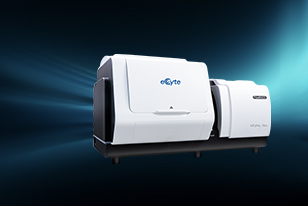


A research team led by environmental engineering experts Hyungmin Choi, Satoshi Okabe, and Mamoru Oshiki from Hokkaido University has published a News & Views article in Nature Water. The commentary highlights an original study in the same issue focusing on microbial interactions during shortcut nitrification, underscoring its broad industry impact. eCyte’s FlowRACS system provided crucial single-cell resolution data that underpinned this breakthrough.
Core Scientific Breakthrough: Quorum Sensing Regulates Stress Responses in Nitrifying Communities
Integrating multi-omics, stable isotope probing, and single-cell characterization, the study demonstrates that quorum sensing (QS) signals serve as an endogenous switch driving "metabolic altruistic sacrifice" in nitrite-oxidizing bacteria (NOB)—a mechanism essential for maintaining stable shortcut nitrification. This finding resolves long-standing instability issues in suppressing NOB during mainstream low-carbon wastewater nitrogen removal.
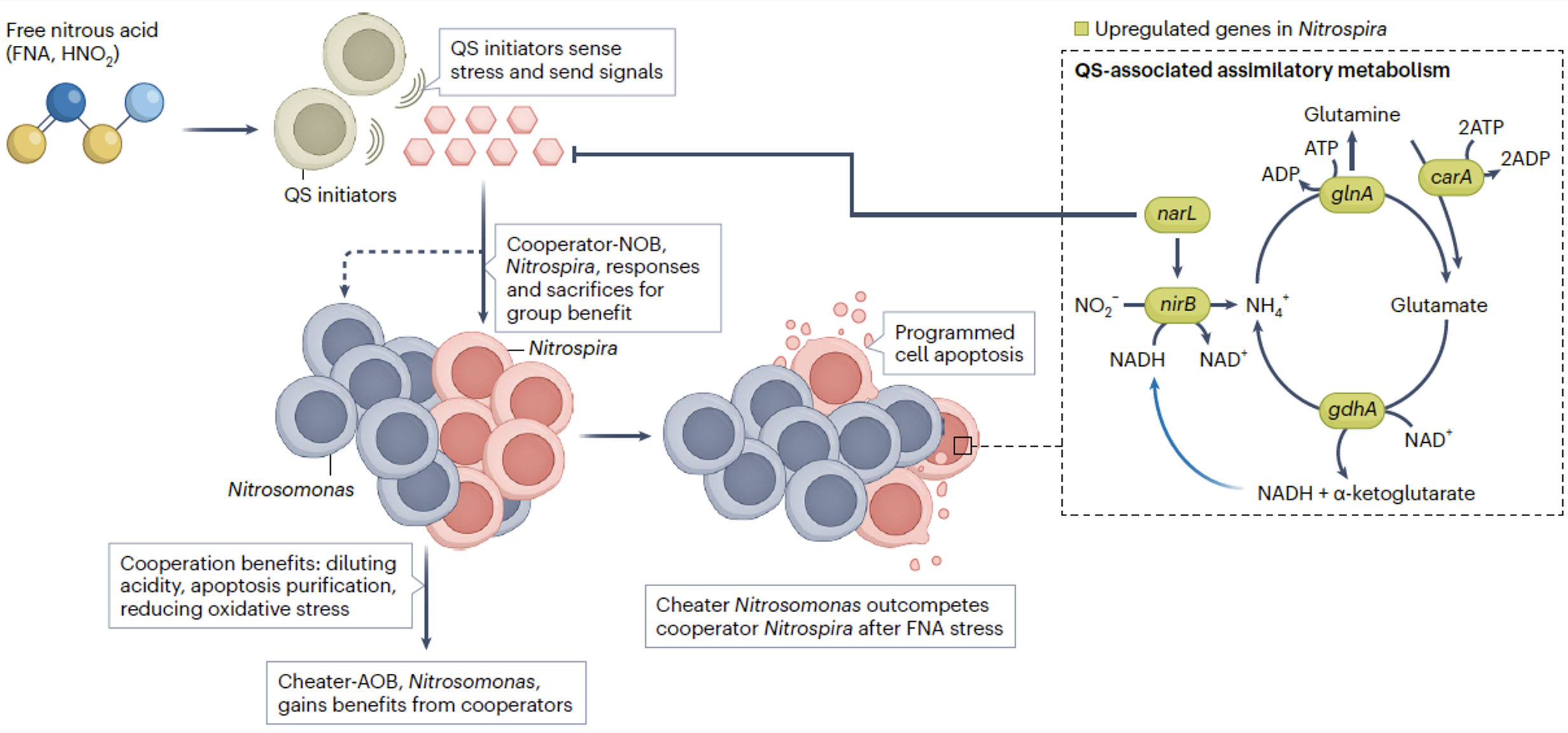
Figure: Metabolic regulation mediated by quorum sensing under free nitrous acid (FNA) stress
Expert Commentary Confirms Industry Significance
The Hokkaido University team commended the work from both evolutionary ecology and engineering perspectives:
Theoretical Innovation: Advances beyond single-strain physiology by incorporating quorum communication and single-cell metabolic heterogeneity into shortcut nitrification dynamics, establishing a new "microbial altruism" paradigm.
Engineering Guidance: Expands traditional process controls (DO, pH, sludge retention time) by positioning QS signaling as a next-generation control strategy for wastewater treatment plants.
Real-World Challenges: Outlines implementation hurdles in complex operational environments with competing background microbes, charting a path forward for global low-carbon wastewater research.
Featuring a dedicated commentary in Nature Water underscores international recognition from leading experts in water environment and microbiology, marking this study as a pivotal milestone in shortcut nitrification research.
eCyte’s FlowRACS: Resolving Microbial Heterogeneity at the Single-Cell Level
Key experimental data distinguishing active nitrifying sub-populations and quantifying single-cell metabolism were generated using eCyte’s FlowRACS. As the world’s first high-throughput single-cell Raman sorting platform, FlowRACS offers key advantages for environmental microbiology:
Label-Free, Non-Destructive Live-Cell Detection: Captures in situ metabolic profiles of AOB and NOB without fluorescent dyes.
High-Throughput Flow Sorting: Differentiates active and inactive nitrifying sub-populations under stress for quantitative single-cell metabolic profiling.
Downstream Compatibility: Pairs sorted cells with stable isotope probing and single-cell multi-omics to establish an end-to-end "Phenotype-Gene-Metabolism" validation workflow.
FlowRACS continues to shift research in wastewater nitrogen removal and environmental microbial ecology from bulk population averages to precision single-cell analysis. eCyte remains dedicated to advancing cutting-edge single-cell instrumentation to empower frontiers in water environmental science.
Contact us and follow us for more videos on eCyte - YouTube and updates via LinkedIn.