

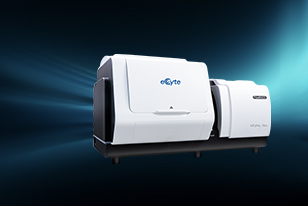


Key Takeaway: A study in Environmental Science & Technology reveals that microplastic-derived organic matter (MP-DOM) accelerates soil microbial respiration and boosts CO2 emissions. Single-cell Raman spectroscopy—the foundational technology powering eCyte FlowRACS—provided crucial, single-cell metabolic evidence to prove this mechanism.

The Environmental Risk: Microplastics Driving Soil Respiration
Soil is the Earth’s largest terrestrial organic carbon pool. However, widespread microplastics (<5 mm) erode under UV light and physical wear, leaching Microplastic-Derived Dissolved Organic Matter (MP-DOM) into the ground. Recent soil microcosm experiments comparing MP-DOM to Natural Organic Matter (NOM) revealed significant impacts:
Surging Emissions: Soil treated with MP-DOM emitted 36.9%–42.3% more CO2 than NOM groups.
UV Acceleration: Photo-aged MP-DOM induced 27%–43% higher CO2 release than unaged MP-DOM.
Faster Degradation: MP-DOM's dissolved carbon degraded at 47.4% in black soil, compared to just 36.8% for NOM.
Why MP-DOM Fuels Soil Microbes
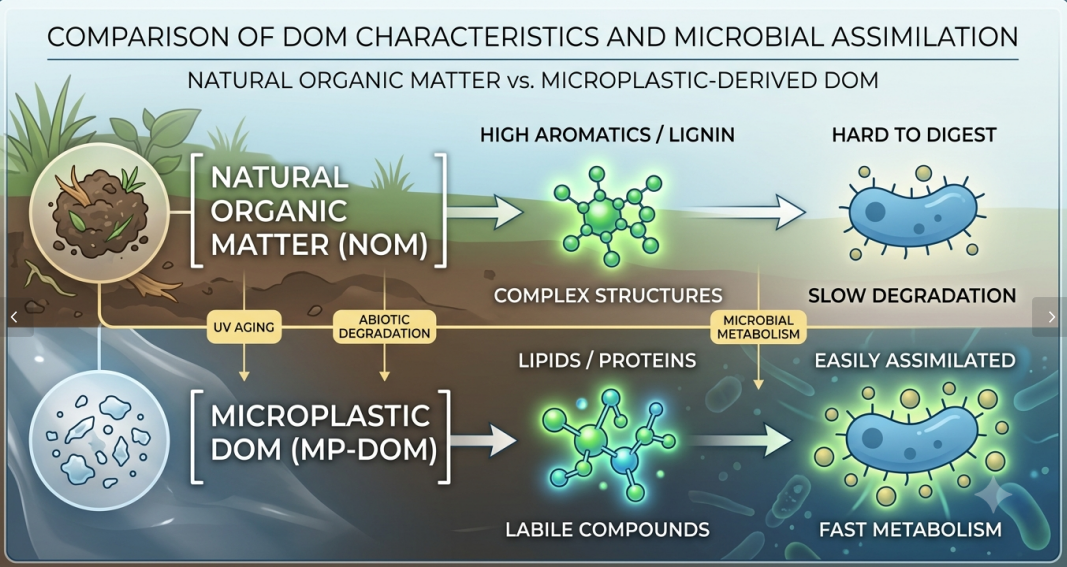
Compared to complex natural matter, MP-DOM acts as an easily digestible carbon source for soil bacteria:
Bioavailable Structure: Over 64% of MP-DOM consists of easily assimilated lipids, proteins, and amino sugars. NOM is dominated by refractory lignin and aromatics.
Higher Efficiency: Microbes process MP-DOM with high thermodynamic efficiency, resulting in rapid growth and elevated CO2 output.
The Technology: Single-Cell Raman Analysis via eCyte's FlowRACS
How It Works?
1. Deuterium Labeling: Microbes incorporate deuterium from heavy water into new biomass, forming C-D bonds.
2. Raman Spectroscopy: Raman lasers detect the ratio of active C-D bonds (2040-2300 cm-1) to baseline C-H bonds (2800-3100 cm-1).
3. Single-Cell Sorting and Quantitation: Calculating the ratio quantifies metabolic activity at the single-cell level.
Key Advantages of FlowRACS Technology
Non-Destructive: Preserves native physiological states within complex soil environments.
Cultivation-Free: Skips culture steps to avoid population bias.
Single-Cell Precision: Eliminates bulk averaging errors to reveal true individual cell activity.
Ecosystem Impact & Global Scale
Microplastics actively reshape soil microbial dynamics and carbon cycling. By offering non-invasive, high-throughput metabolic profiling at single-cell resolution, eCyte FlowRACS empowers researchers to dissect critical environmental processes and advance global carbon research. MP-DOM triggers broader ecological shifts across soil micro-environments. Globally, topsoil leaches 16–120 million tons of MP-DOM annually, contributing to 0.28–10.15 million tons of additional terrestrial CO2 emissions per year.
Contact us and follow us for more videos on eCyte - YouTube and updates via LinkedIn.