

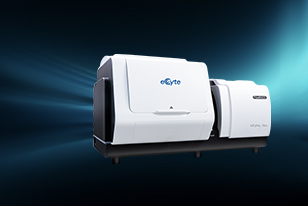


As the global economy shifts toward sustainability, synthetic biology and biomanufacturing have emerged as the single most critical cross-disciplinary technology capable of reshaping heavy industries. Over the next decade (2026–2036), this sector is projected to undergo exponential growth, completely restructuring global supply chains across pharmaceuticals, chemicals, agriculture, environmental protection, and new energy.
At the center of this biological revolution lies a single, critical bottleneck: the ability to identify, screen, and select the highest-performing microbial strains at high throughput. As a global pioneer in single-cell Raman sorting and automated high-throughput strain screening instrumentation, eCyte is uniquely positioned to accelerate this ten-year industry roadmap, turning biological potential into industrial reality.
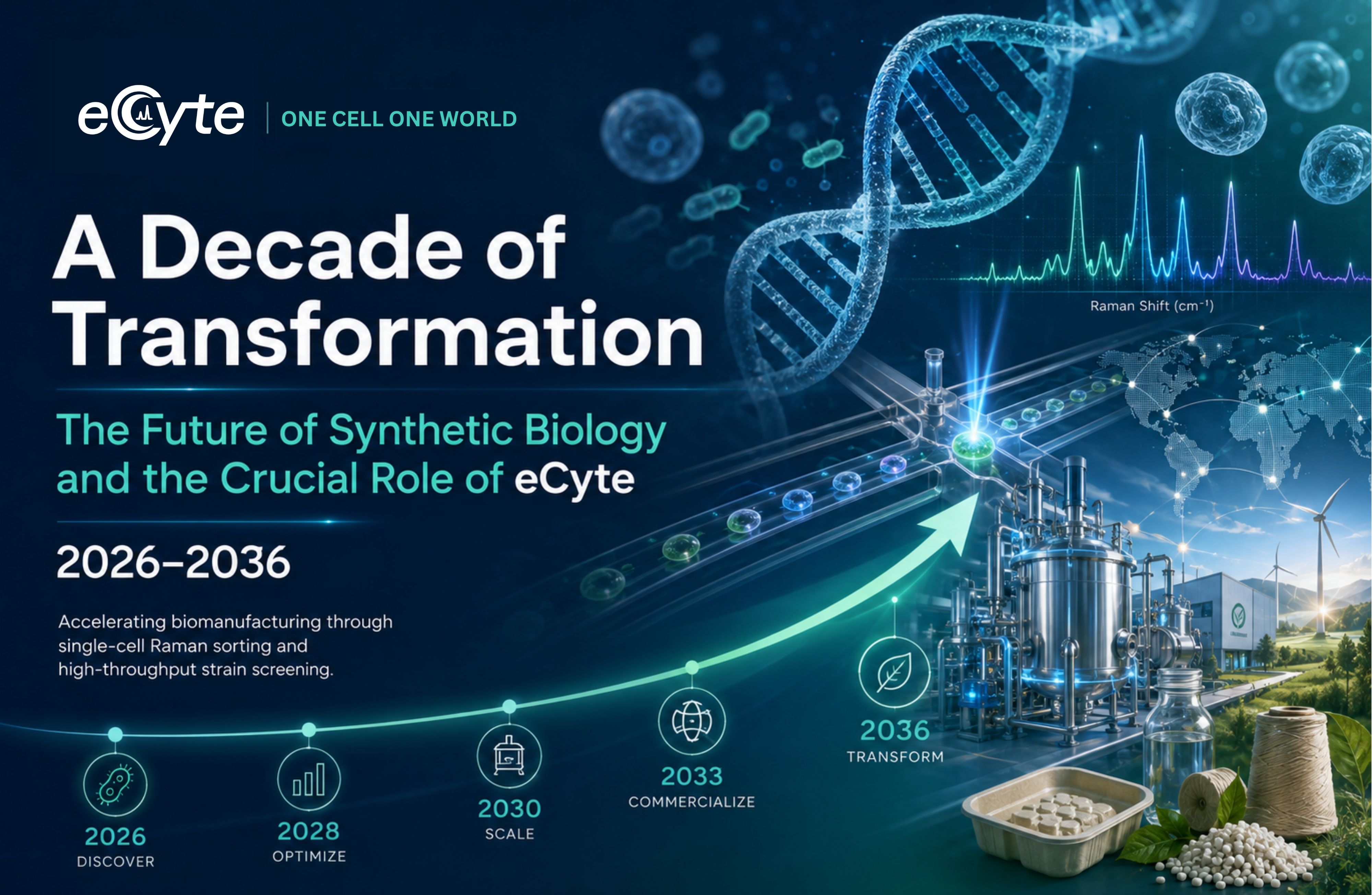
The Three Phases of the Global Biomanufacturing Blueprint (2026–2036)
The transition from petro-based manufacturing to bio-based alternatives will unfold in three distinct macroeconomic phases over the next ten years:
Phase 1 Industrialization (2026–2030): Overcoming engineering bottlenecks, validating bio-based materials, and developing platform cell factories.
Phase 2 Commercial Scale-Up (2031–2033): Achieving cost-parity with fossil-fuel alternatives, driving multi-trillion-dollar market growth.
Phase 3 Universal Maturity (2034–2036): Transitioning into the mainstream production paradigm where bio-fabricated products dominate global markets.
The Critical Bottleneck: Upstream Instrumentation
While the market potential is massive, biomanufacturing cannot scale without sophisticated upstream tools. The entire value chain relies heavily on the "Design-Build-Test-Learn" cycle. Historically, the "Test" phase—screening millions of mutated or engineered microbes to find the single cell that produces the highest yield—has been a slow, costly, and inefficient manual hurdle. Traditional screening methods often require destructive fluorescent labeling or lengthy cultivation periods, creating massive data gaps and slowing down commercialization timelines.
eCyte's Core Mission is to bridge the gap between upstream genetic engineering and downstream mass production by delivering non-destructive, label-free, ultra-high-throughput single-cell analysis and sorting technology.
How eCyte Empowers the Bio-Revolution
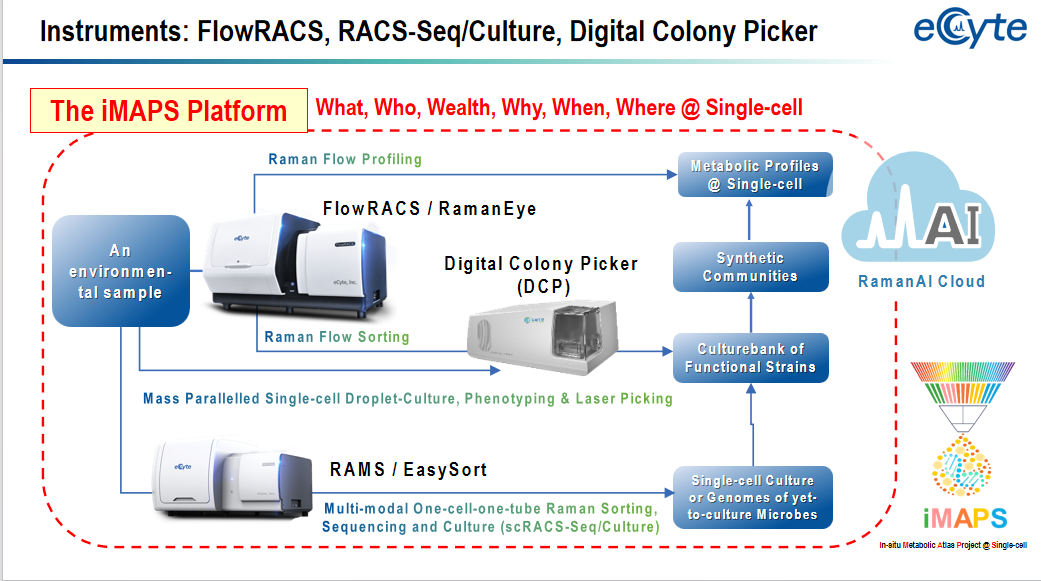
As a foundational technology provider at the absolute apex of the upstream sector, eCyte’s proprietary Single-Cell Raman Sorting and high-throughput strain screening equipment serve as a catalyst across the global supply chain:
1. Non-Destructive Analysis without Labeling
eCyte’s state-of-the-art instruments utilize single-cell Raman spectroscopy to obtain chemical fingerprints of living individual cells in real time. Unlike traditional flow cytometry, this approach requires no fluorescent labeling, preserving cell viability and allowing chosen candidate cells to be directly cultivated downstream.
2. High Throughput, Fully Automated Single-Cell Analysis and Sorting
By automating the detection and sorting of individual cells based on their metabolic profiles, eCyte compresses the time required to isolate superior "super-strains" from months to days. This dramatically shortens the R&D lifecycles for midstream platform cell development and downstream product commercialization.
3. Multi-Industry Empowerment
Whether it is identifying high-yield lipid-producing algae for new energy, selecting optimized yeast strains for bio-based chemicals, or isolating functional single cells for gene therapies, eCyte’s technology provides the universal precision required by modern biotechnology laboratories globally.
Looking Ahead: Driving Global Tangible Benefits
The next ten years will completely redefine humanity’s relationship with manufacturing. By providing the essential high-throughput screening infrastructure, eCyte is not just watching the bio-economy unfold— we are building the engine that drives it forward.
Contact us and follow us for more videos on eCyte - YouTube and updates via LinkedIn.